
B2B agency selection · Reviewed
Top 10 B2B Lead Generation Agencies: Compare the Campaign Scope
Compare ten agency scopes with S-196 and an editable local draft worksheet. Separate buyer requirements from unknown supplier answers.
S-196: prepare a scope discussion
Enter draft answers from your own proposal discussion. Every supplier answer starts unknown. The count describes completed fields, not agency quality.
Two agency proposals can use the same service name while assigning different work to your team. One may return a researched contact list. Another may prepare messages and operate an agreed email campaign. A third may require a separate agreement for replies and meetings. Compare the work that crosses each delivery boundary before comparing the headline fee.
This guide proposes S-196, a buyer requirement register for comparing ten B2B lead generation agencies. The accompanying worksheet keeps your requirement, a proposed supplier answer and the evidence still needed in separate fields. It exports a draft locally in your browser. It does not contact an agency, submit your requirements or determine which supplier you should hire.
TopClick appears first because this is an affiliated guide written by its CEO. This editorial placement does not establish independently measured superiority. Nine other providers follow alphabetically. Their public service descriptions were reviewed on November 20, 2026. The Hartwell example is fictional, and no provider was hired, interviewed or tested for this comparison.
Begin with work your team cannot yet assign
Write the missing task in operational terms. We need more pipeline leaves the commission open to several interpretations. A buyer might need researched accounts for an existing SDR, an operator for an approved campaign or help reviewing responses already waiting. Each situation has a different starting input and a different receiving decision.
Identify what is already available inside the business. An employee's title does not establish time allocated for the proposed work. Access to a CRM does not establish an agreed handoff process. Record the actual responsibility and the person authorized to accept the returned output. Unknown capacity remains a question for the buyer rather than a reason to assume the largest package is necessary.
Salesforce Trailhead advises, "Determine the criteria that define the qualified prospect for their company." Its lead qualification model lesson provides context for agreeing qualification criteria. S-196 is a separate proposed purchasing aid. The quotation does not validate the worksheet, recommend any provider or establish a supplier's performance.
Use one requirement per row. Research output, sending ownership and reply handling are related, but a single yes for all three can conceal an important exclusion. The worksheet deliberately keeps requirements separate. The export is useful when another reviewer can identify what the buyer requested and which part of the response remains unverified.
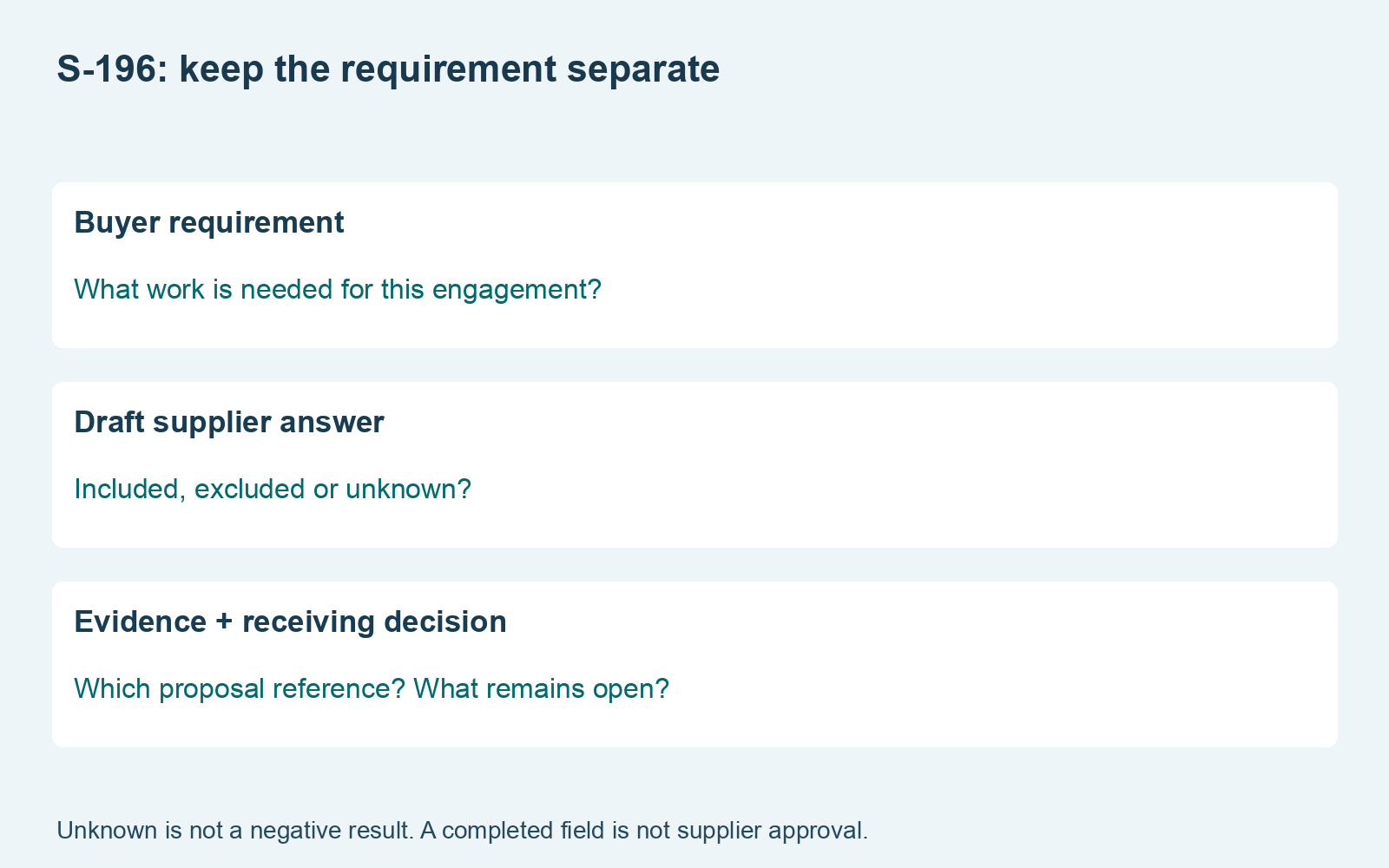
S-196: a requirement is different from a supplier answer
The first field states the buyer's requirement. Specify whether it is needed for this engagement rather than marking every possible service as desirable. A research-only commission may have no need for external campaign operation. An already-running campaign may need a receiving handoff without requiring a new prospect list.
The second field records the supplier's proposed answer. Use included, excluded or unknown only after the relevant discussion. This public worksheet starts with unknown answers. None of its controls certifies what a named provider sells or approves a contract. A public menu can help frame a question while leaving the actual offer unresolved.
The evidence note identifies the proposal clause, specimen or explanation a reviewer should examine. Do not paste customer contact data or credentials into a procurement worksheet. A reference to a privately held document can identify the relevant evidence without reproducing confidential material in a shared draft.
The receiving decision names what the buyer will do with the output. A returned list needs a reviewer who can accept its agreed fields. A campaign packet needs message approval and an operating owner. A reply handoff needs someone who can decide the next commercial action. The service label does not allocate that client authority.
The worksheet's completion count concerns required rows with an explicit draft answer. It is not a supplier score or an evaluation of quality. An excluded answer is still explicit and can reveal a gap in the proposed commission. An unknown answer remains open even when other rows have been completed. Exported records retain their draft and example-only status.
Ten agencies through the same scope questions
For each entry below, separate the public observation from the proposed buying question. The same lens applies throughout: starting input, work performed, returned output and buyer dependency. The entries make no price comparison and supply no performance ranking. A capability not established by the reviewed page remains something to ask about, not a confirmed absence.
1. TopClick
The published scope for TopClick - B2B lead generation describes target-account research, contact preparation, messages, agreed campaigns and response handoff. It offers managed work or separately commissioned parts. The combined email and LinkedIn scope uses a shared contact allocation and a shared reply log; profile owners perform manual platform actions.
Ask which services the proposed order includes and what the client must supply. Reply handling and meeting booking have their own scope. Obtain the qualification owner and actual appointment event definition before interpreting a campaign package as an end-to-end sales commitment. A published service boundary is a starting point for that agreement, not a guarantee about replies, meetings or revenue.
2. Belkins
Belkins' pricing page describes lead research, validation and appointment-related work, with several engagement levels. It also names copywriting, reporting and appointment coordination in its service descriptions. These observations suggest several distinct delivery boundaries that a buyer should inspect rather than treating the package name as a complete specification.
Ask which starting inputs the proposed team needs and which returned records the buyer receives. Separate research acceptance from meeting acceptance. Obtain the handling of corrections and appointment changes within the actual order. A broad service list does not establish that every listed task belongs to the selected engagement or removes the buyer's approval responsibilities.
3. Callbox
Callbox presents lead generation and appointment setting through coordinated outreach channels. Its public description combines account research with email, LinkedIn and phone activity and human involvement in conversations. These are observations about its stated service model; the comparison does not inspect a client campaign or infer a fixed channel mix for every commission.
Ask who prepares, approves and operates the proposed channels. Identify the returned conversation context and the person receiving it. Where several channels concern the same contact, obtain the agreed coordination rule. A buyer needs to know how a response changes the next planned action, without assuming that a multichannel label supplies the relevant stop or handoff definition.
4. CIENCE
CIENCE's pricing page distinguishes campaign-team, platform and SDR components. It describes preparation and ongoing campaign work alongside the tools and people involved. Those distinctions are useful when a buyer needs to understand which part of a proposed engagement is an operating service and which part supplies the environment used to perform it.
Ask which components the actual proposal requires and which responsibilities remain with the client. Obtain the deliverable associated with each stage rather than comparing a platform component directly with a complete campaign service. Keep buyer approval, supplier activity and the client's later opportunity decision separate in the commissioning record.
5. Leadium
Leadium presents B2B lead generation and sales appointments. Its public intake distinguishes needs involving contact data, deliverability and outbound consulting. That range reinforces the need to identify the missing task before requesting a proposal. An intake category does not by itself specify the returned file, operating boundary or acceptance process for the resulting work.
Ask for a scope description tied to the buyer's requirement. If the commission concerns contact data, establish the record fields and correction route. If it concerns outreach, establish the sender, approved materials and receiving handoff. Preserve an unanswered boundary rather than copying assumptions from a different service category into the comparison.
6. Martal Group
Martal Group lists outbound lead generation, appointment setting and sales outsourcing among its services. Its public material also names several outreach channels. Those observations make it relevant to a buyer considering outside sales development, while leaving the specific division of work to the proposed engagement.
Ask what the supplier performs, what the client approves and what the receiving team must decide. Obtain the meaning of the returned lead or appointment record in that scope. If the buyer already has an internal sales team, establish which activities remain internal. Do not presume that an outsourced team removes the need for a named client owner.
7. Pearl Lemon Leads
Pearl Lemon Leads describes prospect research, written outreach, telemarketing and appointment setting. Its public page discusses qualification and reporting alongside those activities. The comparison records that range without treating it as a promise that every task is included in one package or available under identical conditions for every buyer.
Ask which research, execution and review tasks belong to the proposed order. Request a specimen of the returned context with personal information appropriately removed. Identify who resolves an unclear qualification field and who may authorize the next action. Preserve the distinction between a delivered observation and the client's decision to accept a commercial opportunity.
8. SalesAR
SalesAR's packages page describes outbound engagement models and email and LinkedIn elements, with reporting and strategy review in its scope details. A buyer can use those observations to ask how preparation, campaign operation and review relate within the selected engagement. The page does not replace a commission-specific statement of work.
Ask which inputs are required before launch and which outputs recur during delivery. Establish the route for approved changes to targeting or messages. Keep the original brief reference when a later review changes the proposed next test. A recurring review should not silently expand the work beyond the service boundary the parties actually agreed.
9. SalesHive
SalesHive describes managed outbound services covering several activity types, with reporting and meeting-related workflows. Its service descriptions distinguish choices a buyer may need to compare. They do not establish the operating details of a particular client's access arrangements, target segment or receiving sales process.
Ask which channel activities the supplier will run and which client dependencies must exist first. Identify the returned reporting packet and the meaning of its next-action field. A proposed supplier can explain the scope without receiving unrestricted access to the buyer's systems. Keep authorization and credential handling within the buyer's established process.
10. SalesRoads
SalesRoads presents appointment setting, lead generation and outsourced SDR services. Its public program description names CRM integration and a live performance dashboard alongside calling and email prospecting. Those are published scope observations only; no integration or dashboard was tested and no outcome was measured for this guide.
Ask which parts of the proposed workflow are supplied and which are client dependencies. Obtain the relationship between a conversation record, an appointment and the buyer's later acceptance decision. An integration capability does not establish an agreed field mapping or authorize the supplier to decide the buyer's commercial stage. Record the actual handoff boundary in the proposal.
Hartwell: three requirements, one unresolved boundary
Read the six worksheet rows as separate commissioning questions. Research asks what account and contact material returns to the buyer. Message preparation asks who writes the proposed claims and how the client approves a version. Those tasks can share inputs while producing different outputs. A research file does not establish that any wording has been approved for use with the people it identifies.
Channel operation asks who performs the permitted activity. Specify the actual channel, account owner and client dependency outside the public worksheet. An included answer without those details is a draft response to investigate, not permission to act. If an internal owner performs a manual platform action, preserve that role even when an outside team prepares the queue and records the result.
The shared reply log row concerns the returned context and its relationships. Ask whether the buyer receives the contact reference, observed response and next-action status under the agreed arrangement. This requirement can exist even when the buyer handles every reply internally. Do not mark reply handling included merely because a shared log is part of the campaign output.
Reply handling asks who performs the agreed review or follow-up work and where it stops. The client may retain decisions about product details, exclusions or an existing opportunity. A supplier answer should identify the route for those questions. If that route is missing, keep it in the evidence note even after entering an explicit included answer for the general task.
Meeting booking asks which event the service performs and what the agreement counts. A proposed calendar action, a buyer-accepted invitation and observed attendance are different conditions. Obtain the actual scope and fee trigger. The worksheet supplies no default commercial definition, and choosing included cannot substitute for the buyer and provider agreeing what the delivered event means.
An excluded response to a required row is a visible scope gap. It can be a reasonable answer if the buyer decides to cover that work internally or commission it separately. Preserve the original requirement while recording the next owner elsewhere in the buyer's process. The tool deliberately does not turn an explicit exclusion into a positive provider recommendation or hide it because the row has been discussed.
An unknown response is a different kind of gap. The buyer does not yet have an answer to interpret. A public page may be silent about a narrow request while the provider can address it in a proposal. The appropriate next step is to ask, retain the actual response and review its conditions. Do not treat unknown as a failure of the provider or invent an included answer from a broad marketing phrase.
Before exporting, read the requirement and answer together with the evidence note. A note can identify a conflict that the short selection alone cannot express, such as included only after a client supplies a message approver. The exported draft preserves that text for the receiving reviewer. Its row-completion count cannot determine whether the condition has been satisfied, and it does not erase an unresolved dependency merely because a selection was made.
Fictional Hartwell already has an SDR authorized to send approved messages. Its immediate need is researched contacts for one proposed segment. The buyer marks research as required and external sending as not required. This is a premise for the example, not evidence that an actual business has sufficient internal capacity or that research-only procurement is always preferable.
Hartwell also marks a shared reply log as required because the receiving team wants one view of responses. It leaves reply handling and appointment booking outside the initial commission while those responsibilities are discussed. Separating the rows lets the buyer ask for the record structure it needs without implying that the supplier will perform every later sales task.
Now consider a draft response that explicitly includes research and excludes operating the campaign. Those answers do not establish the shared-log boundary. If that row remains unknown, the worksheet keeps it open. The buyer can complete two requirement discussions while still lacking the information needed to commission the proposed handoff.
The next action is a question, not an automatic supplier ranking. Ask whether the proposed delivery includes a shared reply record, what the client must operate and how the agreed references relate. A returned spreadsheet may satisfy the research task while requiring another arrangement for ongoing response context. Keep that dependency visible before accepting the initial scope.
Compare the returned output before the unit price
A researched contact, an attempted send, a reviewed reply and an attended meeting are different commercial units. A lower displayed amount does not establish a lower cost for the work this buyer needs. Obtain the actual unit definition, inclusions and client dependencies before making a cost comparison. This guide supplies no assumed conversion between those units.
For a research deliverable, ask what one record represents and which fields the buyer will inspect. A company row and a person row answer different questions. A correction can improve an existing record without becoming another distinct prospect. Preserve the relationship between original and revised records instead of adding every file row into one unexplained total.
For an operating engagement, identify the approved channel and the person entitled to use it. A supplier can prepare materials while an account owner performs a manual action. The proposed service boundary should preserve that distinction. Neither a worksheet selection nor an export grants access to a profile or authorizes the sharing of credentials.
For reply work, name the review allowance and receiving owner. Time available for review is different from a promise that every response will be resolved. The buyer may need to answer product or commercial questions that the supplier cannot determine independently. Obtain the escalation and return route for those questions before treating reply handling as a completed sales process.
Make acceptance usable by the receiving team
Define acceptance against the commissioned output. A buyer can accept a file's agreed structure while leaving a particular qualification question unresolved. Another reviewer may accept a later handoff for sales follow-up. Those decisions concern different requirements. Preserve their roles rather than using one accepted flag to imply that all earlier and later work has been approved.
Request a permitted specimen early enough to expose ambiguity. A fictional or redacted packet can show record meanings, source references and correction handling without disclosing another customer's data. Ask the receiving reviewer to identify the next decision from that specimen. If the reviewer needs the supplier to reconstruct every column orally, clarify the field dictionary before increasing volume.
Document how changes reach the people using the output. A revised target segment can affect research, message approval and later qualification. Identify which existing records remain in scope and which need another review. The comparison should retain that boundary rather than implying that a new brief retroactively changes the evidence behind earlier deliveries.
Use the local export as a discussion record
The worksheet contains a provider selector, six possible requirement rows and editable evidence notes. Changing the selected provider clears draft supplier answers and notes after a visible confirmation, so an answer entered for one agency is not carried to another accidentally. Required-row choices remain the buyer's brief. No provider receives a readiness score or an automatic recommendation.
The export includes the selected agency, the buyer's requirements, draft answers and unresolved required rows. It retains example_only=true and review_status=draft. Its completion count means that an explicit answer was entered, including an excluded answer. It does not certify that the answer is accurate, supported or commercially acceptable. The receiving team must inspect the actual proposal.
All editing and export work takes place in the browser for this worksheet. There is no submission form, background contact request, account connection or persistent browser storage. Reloading the page discards edits. Download the draft if you want to retain it, and keep sensitive commercial information in your own approved records rather than entering it into a public example.
Finish with the unresolved condition and its next owner. Hartwell's missing shared-log answer is one example; another buyer may need a message approver, a channel operator or an appointment definition. A useful supplier comparison makes that condition inspectable. Commission the selected work after the people who must approve, operate and receive it understand their part of the agreement.
More insights to read
Best 10 B2B Lead Generation Agencies: Compare Prospect List Quality
How to Compare B2B Lead Generation Agencies: ICP and Qualification Requirements
How to Choose a B2B Lead Generation Agency: A Buyer's Scope Checklist
Top 10 B2B Lead Generation Agencies: Outsourced Outreach or an In-House SDR?
Best 10 B2B Lead Generation Agencies: Cold Email, LinkedIn or Both?
About the author

Written by Dmytro Nasyrov PhD, software architect with 24 years of production experience. Dmytro is the CEO of TopClick.